5 Essential Commercial Cleaning Equipment for Industries

Floors take more abuse than any other surface in a building. Customers track in dirt, staff spill coffee, and carts leave scuff marks. Within a week, a lobby that looked great on Monday can look tired.
Keeping commercial floors clean doesn’t take a fleet of machines. Five basic tools handle daily cleaning in offices, stores, schools and warehouses alike. Here’s what to stock and which products to order on Buy Direct.
5 Essential Commercial Floor Cleaning Tools
1) Dust Mops
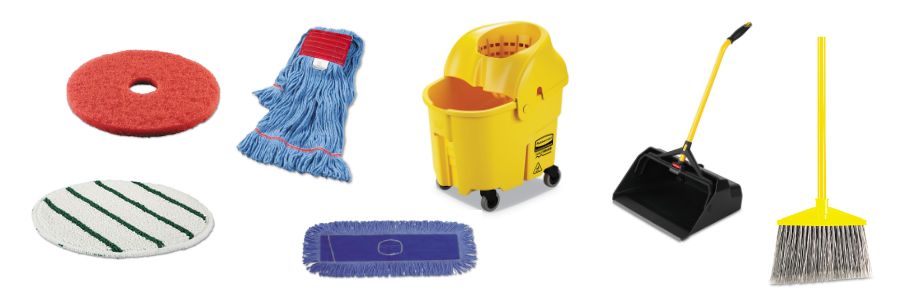
A dust mop is the fastest way to pick up dust, grit and hair on hard floors before you wet mop. Grit is what scratches floor finish, so dust mopping daily keeps floors looking newer for longer. The Genuine Joe Cotton Dust Mop Refill fits a standard 24-inch frame and is easy to shake out and swap.
2) Wet Mops and Mop Handles
Microfiber picks up more dirt than cotton and uses less water and chemical, so floors dry faster. Pair the Genuine Joe Microfiber Wet Mophead Refill with a Rubbermaid Commercial Gripper Mop Handle , a lightweight fiberglass handle with a clamp that makes swapping heads quick.
3) Mop Bucket and Wringer
A good wringer means less water left on the floor, which means fewer slip hazards and streaks. The Genuine Joe 35-Quart Side Press Mop Bucket & Wringer Combo rolls on casters and holds enough solution for a large area, so your team spends less time walking back to the sink.
4) Floor Cleaner and Floor Pads
For daily mopping, a neutral cleaner removes dirt without dulling floor finish. MISTY Neutral Floor Cleaner is a concentrate, so one bottle makes a lot of solution. If you use an auto scrubber or floor machine, keep pads on hand too. The Scotch-Brite High Productivity Pad 7300 is a heavy-duty black pad for deep scrubbing and stripping.
5) Brooms and Dustpans
Spills and debris don’t wait for the nightly clean. A lobby broom and upright dustpan let staff clean up quickly without bending over. The Genuine Joe Plastic Lobby Broom pairs well with the Lobby Pro Upright Dust Pan , and both are easy to keep behind a counter or on a janitor cart.
Don’t Skip the Wet Floor Signs
Wet floors cause slip-and-fall injuries, and a sign is the simplest way to warn people. Put one out every time you mop, and pick it up once the floor is dry so people keep paying attention to them. The Rubbermaid Commercial 25" Caution Wet Floor Safety Cone is bilingual (English and Spanish) and easy to see.
Who Should Buy Commercial Floor Cleaning Tools?
Janitorial companies, facility managers and in-house cleaning teams in offices, retail stores, schools, restaurants, warehouses and medical facilities all need these basics. If you manage more than one building, buying in bulk keeps every site stocked and costs down.
Buy Floor Cleaning Supplies from Buy Direct
The right tools make floors faster to clean and keep them looking good between deep cleans. Order mops, buckets, brooms and floor cleaner on Buy Direct with free delivery and no minimum, or talk to your Mission Rep about adding them to your regular order.
FAQs
What equipment do you need to clean commercial floors?
Most commercial buildings need a dust mop, a wet mop with a handle, a mop bucket with a wringer, a neutral floor cleaner, a broom and dustpan, and wet floor signs. Larger facilities often add an auto scrubber or floor machine with matching pads for deep cleaning.
How often should commercial floors be cleaned?
High-traffic floors such as lobbies, entrances and restrooms should be swept or dust mopped and then wet mopped every day. Lower-traffic areas can often go a few days between mopping. Most facilities also schedule periodic deep scrubbing and refinishing based on how worn the floor looks.
How should cleaning equipment be cleaned and stored?
Rinse mop heads and buckets with clean water after each use to remove leftover chemicals, then let everything air dry before storing it. Launder microfiber mop heads separately, without fabric softener. Store mops with the heads up so they dry fully and don’t grow mold or bacteria.
Trending in Industrial
Best delivered price — free delivery, no minimum.